
Selecting the correct ultrasound paper is far more important than simply stocking a supply closet. The right ultrasound media affects image clarity, patient experience, documentation accuracy, printer reliability, and long-term cost efficiency.
Different facilities, including diagnostic clinics, Ob/Gyn offices, and 3D/4D baby ultrasound studios, rely on printed output for different purposes, and Sony has developed specialized papers for each of those needs.
The UPP series supports thermal black-and-white printing, while the UPC series uses dye sublimation for true photo-grade color. Understanding the differences among these formats allows your team to choose the media that aligns with your workflow and ensures consistency in both image quality and operational performance.
Standard Ultrasound Printer Paper (Black & White) for Clinical Documentation
Sony UPP-110S widely used thermal paper in clinical ultrasound imaging. Designed as a Type I normal-density A6 thermal medium, it is ideal for prints that will be uploaded to the EMR, transferred into PACS, used for routine obstetric and gynecologic imaging, or archived for reference. Sony formulates this paper for stable grayscale output and smooth paper feeding, which limits jamming and reduces reprints, an important factor for high-volume diagnostic environments.
It is also regarded as the most cost-efficient ultrasound printing paper in Sony’s range, making it the preferred choice for facilities that need dependable image quality while maintaining long-term supply cost control.
For facilities such as urology clinics or centers performing biopsies under ultrasound guidance, where stronger contrast and more visible gradation can assist in differentiating subtle structures, Sony offers UPP-110HD. This high-density variant deepens blacks, sharpens diagnostic detail, and produces a richer tonal range that can be especially useful for interventional work or studies that require clearer visualization of tissue interfaces.
In addition to its enhanced density, UPP-110HD maintains Sony’s consistent thermographic coating and reliable transport, which supports uninterrupted workflow in demanding clinical settings.

Glossy Ultrasound Thermal Paper for Patient-Facing Imaging
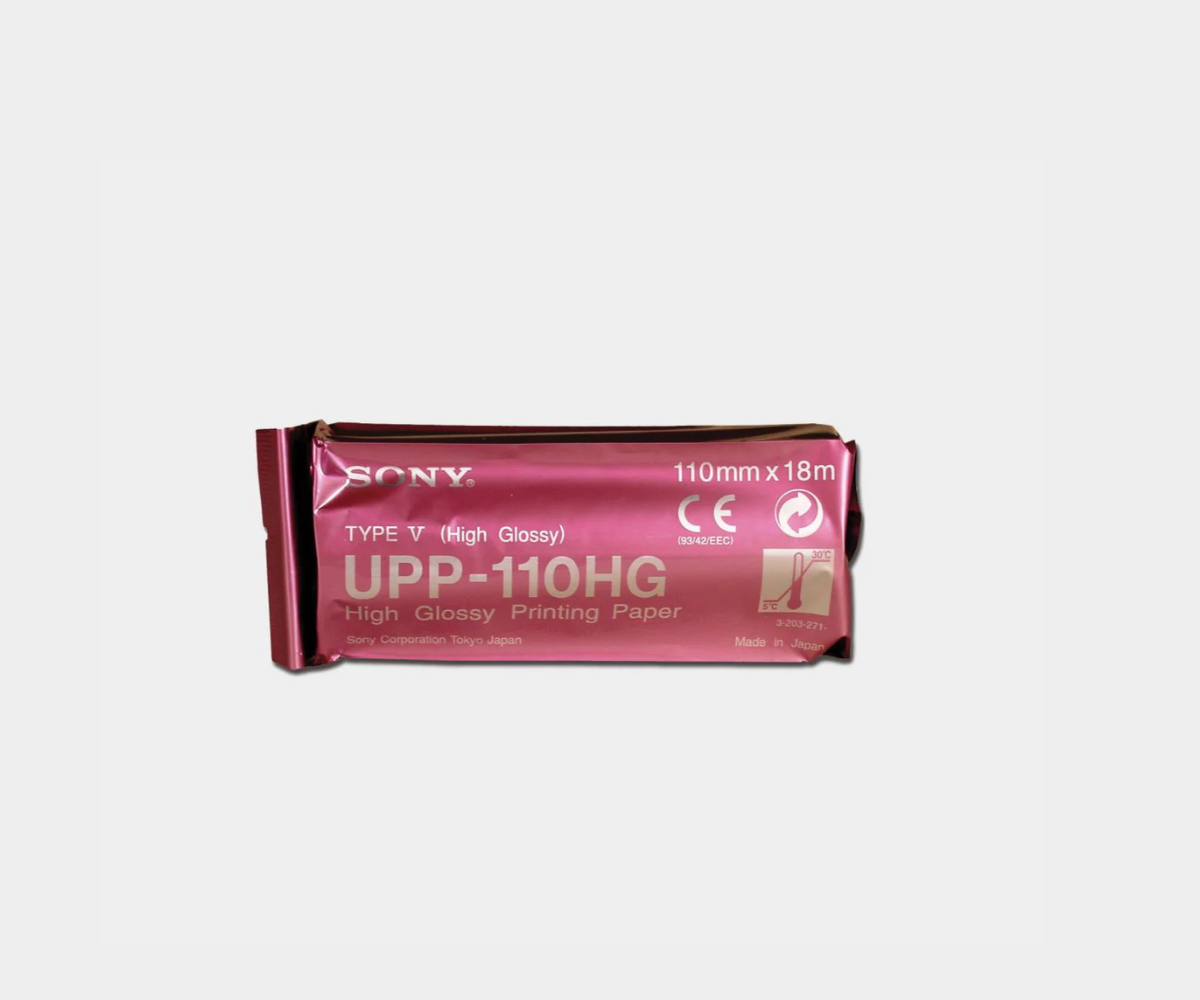
When an ultrasound print is intended to be handed directly to a patient or included in a keepsake package, the expectations shift. Sony UPP-110HG is ideal for these situations. Classified as a Type V glossy A6 ultrasound thermal paper, it uses a specialized coating that resists fingerprints and moisture while producing a finish closer to photographic paper. Although it is still black and white, the smooth highlight response and polished appearance make it appealing for 3D and 4D ultrasound studios where emotional impact influences patient satisfaction and business reputation. Many practices reserve this premium paper for sessions where the print itself is part of the patient experience.
A4 Ultrasound Paper Format for Reporting and Multiview Presentations
Some ultrasound systems are designed for structured reporting rather than single-image prints. In these workflows, Sony UPP-210HD is the appropriate A4 high-density option. Compatible with larger printers such as the Sony UP-991AD or UP-971AD, this format supports annotations, measurements, multi-frame imaging, and narrative findings on a single sheet. The larger print area improves readability and facilitates EMR scanning, making it useful for cardiology, radiology, and any specialty that depends on clean documentation and visual clarity in a standardized layout. This format is frequently used where larger ultrasound paper is required for reporting.
Color Printing with Sony Dye Sublimation Media
Color ultrasound output requires dye-sublimation technology rather than thermal printing. Sony UPC media is engineered for this purpose and is delivered as matched paper-and-ribbon sets that ensure consistent color reproduction from print to print. The UPC-21L pack is one of the most established models and includes 200 sheets with four matched color ribbons, each yielding approximately fifty prints. This media supports smooth tonal transitions, accurate skin tones, and durable photographic-style output. It is compatible only with color printers such as the Sony UP-21MD or UP-D25MD. Clinics that provide premium 3D or 4D ultrasound sessions for expectant mothers typically reserve UPC materials for high-value appointments where color realism is part of the service experience.
How to Select the Correct Ultrasound Printer Paper for Your Facility
The simplest way to choose the right ultrasound paper is to match the media to the purpose of the print. Prints intended for EMR integration, PACS transfer, or routine clinician review are adequately served by Sony standard or high-density UPP formats. When a print will be handed directly to a patient, particularly in settings where emotional value influences satisfaction, UPP-110HG offers significantly higher visual impact. Practices that market 3D and 4D imaging as a premium service often require the fully photographic output of Sony UPC media, assuming a compatible dye-sublimation printer is available.
Many facilities successfully combine multiple media types. Standard and high-density papers are used for internal documentation, while glossy or color formats are reserved for patient-facing interactions that benefit from enhanced presentation quality.
Guidance on Quantities, Cost Efficiency, and Inventory Planning
Paper consumption varies significantly across specialties, so inventory decisions should be based on print volume and session type. Clinics that perform a high number of routine scans typically benefit from purchasing UPP-110S or UPP-110HD in multi-box cases, since case-quantity orders often reduce cost per print and minimize supply interruptions. Facilities conducting more than 300 scans per month often find it economical to maintain at least two case equivalents onsite.
For practices offering keepsake imaging or branded 3D and 4D sessions, demand tends to concentrate around specific appointment categories. In these cases, ordering UPP-110HG or UPC-21L in four to eight box increments helps prevent shortages during peak business periods and ensures that ribbon and paper sets remain correctly paired. Maintaining a consistent supply buffer, ideally equal to one month of anticipated usage, prevents rushed procurement and supports predictable cost planning.
Why Sony Advises Against Sony-Compatible Media
Sony consistently states that its print media is engineered to work in direct coordination with the thermal print head. OEM UPP and UPC materials use controlled friction levels, low ionic coatings, and anti-static layers to prevent abrasion, overheating, and density instability. The company also formulates the coatings to resist humidity and curling, which helps maintain predictable feeding and uniform thermal transfer.
Sony-compatible papers often lack these engineered protections. Practices that have switched to non-OEM options frequently experience inconsistent density, increased jamming, degraded grayscale definition, and premature thermal-head wear. Thermal heads are among the most expensive printer components, and one repair often exceeds any savings gained from lower-cost media. Manufacturers also have the right to evaluate whether non-OEM media contributed to printer damage, and this can influence warranty decisions. For these reasons, OEM ultrasound paper remains the recommended choice for maintaining print quality, equipment longevity, and predictable operating costs.

Which Model Should You Order
A simplified selection guide helps buyers choose the correct Sony media for their clinical needs. Routine OB, GYN, and general diagnostic imaging are best supported by UPP-110S, which provides stable grayscale at the lowest cost per print. When deeper blacks and higher diagnostic visibility are required, UPP-110HD delivers enhanced density and contrast. For prints given directly to patients, UPP-110HG offers a glossy finish suited for keepsake-quality presentation. Practices performing 3D or 4D color studies should use UPC-21L, which is the dye-sublimation set that produces true photographic output. Facilities generating structured A4 reports will need UPP-210HD, the format designed for larger medical printers.
Selecting the correct SKU ensures that printed output aligns with both clinical requirements and patient expectations.
Media Selection Overview
|
Media Type |
Best Use Case |
Key Benefit |
|
UPP-110S |
Routine OB/GYN and general imaging |
Most cost-efficient stable grayscale |
|
UPP-110HD |
Higher diagnostic visibility needed |
Deeper blacks and enhanced contrast |
|
UPP-110HG |
Patient-facing prints or keepsake images |
Glossy, premium presentation finish |
|
UPC-21L |
3D/4D color sessions |
Photographic output via dye-sublimation |
|
UPP-210HD |
A4 clinical reports |
Larger-format high-density printing |
Maintaining Printer Reliability and Cost Control
Sony emphasizes that pairing its OEM paper with its printers is the most effective method of protecting the thermal head, ensuring image consistency, and maintaining predictable cost per print. Facilities operating multiple rooms or supporting large patient volumes often find that correct media selection directly reduces service calls and reprint waste. When the media aligns with the intended workflow, clinicians gain reliable density, patients receive clearer images, and administrators maintain tighter control over long-term costs.